Feature Friday: Dominique Sandifer

Sandifer in the 2010 season (Ernie Anderson/SDSU Media Relations

Sandifer overcomes obstacles on the road to success

In the spring of 2011, San Diego State wide receiver Dominique Sandifer was preparing for a big season. It was his time.

He had played two seasons behind NFL-bound receivers Vincent Brown and DeMarco Sampson, and was ready for his chance to take over as the go-to pass-catcher for the Aztecs. 2012 was supposed to be his breakout year.

Sandifer and his teammates were working hard in the offseason, running routes and catching balls from the quarterbacks one day during a week off.

That day, however, one wrong step would put a halt to Sandifer’s plans, and change his road to success in the blink of an eye.

“We were running routes and I ran simple “go” route, and my knee got stuck in the ground,” Sandifer said. “I was hoping it wasn’t that bad at first, but then they told me my (Anterior Cruciate Ligament) was torn.”

For the average athlete, a severe injury like a torn ACL can be tough to overcome, both mentally and physically.

Luckily for the Aztecs, Sandifer is far from average.

Born in Joliet, Ill., Sandifer moved to California at a young age with his mother and sisters. Although his father wasn’t always around, his mother and grandmother did their best to keep him out of trouble.

Sandifer’s mother lived in Long Beach, Calif., while his grandmother lived in nearby Gardena. He spent time at both houses, but eventually moved in with his grandmother when she was able to get Sandifer and his sister into the Beverly Hills Unified School District through her job with the city.

Sandifer started going to school in Beverly Hills in fourth grade, and also began playing football in Gardena. Because of the congested traffic and his grandmother’s work schedule, he endured long, tiring days at a young age.

“I would wake up at 6 a.m. to go to school, rush home, go to practice, and get back home around 9 p.m. and that was about it,” Sandifer said. “I didn’t have time to go out in the neighborhood or anything. My mom really wanted me to play sports to keep away from gangs and other trouble.”

At Beverly Hills High School, Sandifer impressed the football coaches from start, making the varsity football team as a freshman. He played varsity all four years and caught the eyes of college coaches for his impressive play both at wide receiver and cornerback. Sandifer was an all-CIF selection on offense and defense, and although some colleges were recruiting him as a corner, he wanted to continue playing receiver.

San Diego State was a school that saw Sandifer’s potential at receiver, and offered him a scholarship. After taking an official visit, he and his mother agreed that it was the right school, and he made what he calls “the best decision of his life.”

After redshirting in 2008, Sandifer was a key contributor in the third receiver role for the next two seasons. He played in 23 games in 2009 and 2010, notching 49 catches for 561 yards and 2 touchdowns. Although it was frustrating at times playing behind Brown and Sampson, Sandifer learned a lot from the experience.

“It was hard at first, coming in with an idea of how you want to play, but I learned you have to wait your turn and work from the bottom up,” he said. “I ended up learning a lot from them; they were great leaders and it reflected a lot on who I am now.”

Then came the injury.

“It was tough to overcome because I felt like I had paid my dues,” Sandifer said. “I felt it was my turn to step up and prove to everybody that I could be the guy.

It was an extremely hard time in Sandifer’s life, but equally important.

“I feel like everything happens for a reason, and I felt like I got to tutor the young guys and give them the knowledge that I learned from Vincent and DeMarco,” he said. “Now we are deeper at receiver than we’ve ever been. You have to take a positive from everything. If it would help the team, I’d do it all again.”

Cornerback Josh Wade, Sandifer’s good friend and roommate, saw the growth in Sandifer throughout the recovery process. Wade was in a similar situation, as he missed the entire 2011 season due to a torn Achilles tendon.

“It was definitely a maturing process for him,” Wade said. “We both grew up a lot from sitting out and watching the game from a different perspective. It helped that we were going through it together.”

With the 2012 season approaching, Sandifer is back and ready to help the Aztecs any way he can in his final season. A week before the season started, Sandifer was voted as one of three team captains by his teammates, an accomplishment that he will cherish forever.

“That was special,” Sandifer said. “I was a captain in high school, but at the college level it’s really special. It showed me that my teammates respect me and trust me enough to be the captain. It was a humbling experience and I appreciated it a lot.”

In a perfect world, Sandifer hopes to have a successful senior year and get a chance to make an NFL roster next year, but he has made certain to focus on his academics to prepare for life after football. He graduated in the spring with a degree in child in family development, and is now pursuing a master’s degree in rehabilitation counseling.

If football doesn’t work out, Sandifer hopes to work with athletes with disabilities and athletes seeking direction once their playing career is over.

“I want to reach out and help kids,” Sandifer said. “I feel like you shouldn’t be able to tell a kid who was born without a leg that you can’t run. I also want to help athletes who finish sports. I want to help those guys get jobs and stay away from drugs and financial issues.

“A lot of those guys don’t know what to do after sports, they have no direction. Sports is just a short part of your life, and hopefully I can reach out to those people and help them understand that.”

Although he took a small detour, Sandifer is still on track on the road of success. Luckily for others, he is more than willing to share the directions.


LINKS:
Hunter Hewitt: WordPress – http://hunterhewitt.wordpress.com
Hunter Hewitt: LinkedIn – http://www.linkedin.com/in/hunterhewitt
Hunter Hewitt: Twitter – http://twitter.com/hunterhewitt89
Hunter Hewitt: Facebook – http://facebook.com/hunterhewittSDSU
Hunter Hewitt: About.me – http://about.me/hunterhewitt
Hunter Hewitt: BrandYourself – http://hunterhewitt.brandyourself.com/
Hunter Hewitt: GoAztecs.com Player Profile – http://goaztecs.cstv.com/sports/m-footbl/mtt/hewitt_hunter00.html


by Hunter Hewitt

GO AZTECS

Throwback Thursday: Kyle Turley

Turley during his playing days at SDSU (Ernie Anderson/SDSU Media Relations)

If you ask a San Diego State football fan about Kyle Turley, they’ll likely remember him as a consensus All-American that went on to be a first-round pick in the 1998 NFL draft.

If you ask an NFL fan about Turley, they will likely remember him as the man who did everything in his power to protect his quarterback, even if it meant ripping off an opponent’s helmet and launching it into the air.

If you ask these same people about what Turley is doing today, however, it’s unlikely they’ll know about the musician who has been touring the country, performing songs from his albums and raising money for a charity that supports retired NFL players.

That is who Turley is today, and if you ask him, it’s all because of the journey he endured and the people he met along the way.

The Early Years

Turley was born in Provo, Utah, but moved to California at a young age. Before he was on the football field, he could be found skateboarding, surfing, or wrestling for his high school team. It wasn’t until his senior year that Turley played football, and he was put at defensive end and told to simply tackle the ball carrier.

Even though Turley played just one year of high school football, several schools were interested in his raw talent. Iowa State, San Diego State and others extended scholarship offers to Turley, and he took his official visits to help him make his decision.

SDSU was Turley’s third visit, and it ended up being an easy decision for him as he accepted their offer and cancelled the rest of his trips to other schools.

“I grew up surfing and skating, and when I stepped off the plane in Iowa there was three feet of snow and we couldn’t see the football field,” Turley said. “All that wasn’t for me, I was a California kid. I’m glad I made the decision, because I don’t think I would have enjoyed school at any other college like I did at San Diego State.”

Collegiate Career

After redshirting in 1993, Turley had another decision to make when a new coaching staff came in before the next season.

Ted Tollner was hired as the head coach, and he told his players in the first meeting that they could try whatever position they wanted. Turley, who played both offensive and defensive line on the scout team the previous season, chose offensive line.

“It was really tempting for me to play defense. I loved defense, but I also wanted to work with (offensive line coach) Ed White,” Turley said. “It was a tough switch. Reading the play cards for scout team was easy, but I realized quickly how difficult it was because there was a lot more to think about. It took a lot of dedication and mental preparation.”

The switch turned out to be every bit worth it, as Turley went on to have a stellar career at San Diego State at offensive tackle. After being named a consensus All-American in 1997, the New Orleans Saints selected Turley with the seventh overall pick in the 1998 NFL Draft.

NFL Career

In the NFL, Turley played for the Saints, the St. Louis Rams and the Kansas City Chiefs. He was named to the All-Pro team twice in his career – a first-team selection in 2000 and a second-team selection in 2003.

Ironically, Turley was finally able to block for former Aztec running back Marshall Faulk. They were teammates at San Diego State, but Faulk’s last season was the same year Turley redshirted, keeping the two from being on the field together in college. They played together on the Rams in 2003 and 2004.

Turley’s NFL career was cut short due to a string of injuries, but he knew he had much more life to live. After taking a year off to clear his head, Turley decided to move to Nashville, Tenn. and pursue a music career.

Life After Football

An avid fan of music, Turley picked up a guitar at a young age and never let it go. He was also a security guard in college, a side job that helped him earn money and gave him the opportunity to work at concerts of several big-time bands performing in San Diego.

Although many former NFL players would expect shortcuts en route to their next occupation, Turley took the same road any other aspiring musician would.

“I moved to Nashville and went to all the little honky-tonks around town and signed up for open mic nights,” Turley said. “Nobody really knew who I was around there so I could just go out and do my thing. I didn’t have to really talk to anyone; I could just go work on my skills. I ended up recording a record and here we are today.”

Today, Turley has released two albums, and is the co-founder of Gridiron Records. In 2011, Turley launched the Gridiron Tail Gate Tour, where he and others performed at tailgates and local venues at several NFL and college football games.

Gridiron Records is a supporter of the Gridiron Greats Assistance Fund, a non-profit charity organization that helps retired NFL players in need. Turley began donating to Gridiron Greats in 2007 after learning about the organization from Mike Ditka, his former head coach with the New Orleans Saints.

“I knew right away that it would be a great organization that has a true heart for the players,” Turley said. “I decided I’m going to make a difference in this game for the guys that built it and the guys that keep it going. I jumped in feet-first and I haven’t looked back.”

“Full Circle”

Turley is currently working on his third album, and is now a member of the board of directors for Gridiron Greats. He loves his music career and says that he wants to continue to make music for the rest of his life. Ironically, he feels similar to how he did before making the difficult transition to offensive line.

“I don’t have to think about too much, kind of like playing defense,” Turley said. “In a full circle kind of way, that’s what music is to me. It allows me to be who I am; I can just be free. That’s what I loved about playing defense, and that’s what I love about music.”

After years of battling in the trenches of the offensive line, Turley is finally free again.

The only difference?

He doesn’t have to find a ball carrier to tackle; it’s just him and the music.


Turley throwing the spear into the ground before a game in the 2011 season. He was a member of the SDSU Hall of Fame Class of 2011. (Ernie Anderson/SDSU Media Relations)


By Hunter Hewitt

Warrior Wednesday: Mark Haines

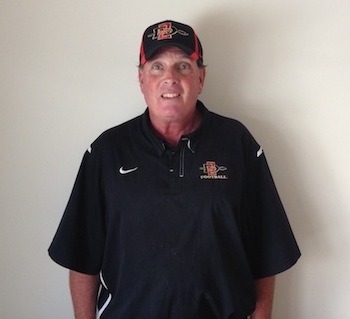
This week’s Warrior Wednesday story is on athletic trainer Mark Haines. Haines has been working with San Diego State for over 20 years, and is a huge part to the success of SDSU athletics. His friendly personality is contagious throughout the athletic center, and he is a favorite amongst men and women from all sports.

Haines grew up in East Lansing, Mich., near the campus of Michigan State. After high school, he attended Metropolitan State College in Denver, Colo. After completing general education courses, Haines was unsure of what the next chapter of his life would consist of.

One day while walking down a hallway on campus, he came across a flyer that said there was a need for athletic trainers. Intrigued by the opportunity, Haines poked his head in the door and asked for more information. He was a big fan of sports – he played several in high school – and he felt that it would be a fun thing to try.

After graduating, Haines was once again unsure of what was next for him. While working at a high school sporting event one day, he bumped into a trainer who attended Michigan State for its athletic training graduate program.

After discovering that his hometown school had the graduate program he was looking for, Haines made a call and sent in his application to become a graduate assistant. Although he was the last one to turn in his application, Haines was fortunate to receive the opportunity he was looking for.

“I called pretty late but the trainer told me to give it a shot,” Haines said. “I got lucky because a few weeks later, the person who was supposed to be the graduate assistant backed out last minute, and the trainer called me first. My application was the last one submitted, and he picked the one off the top of pile.”

Following his time at Michigan State, Haines began looking for a full-time job as an athletic trainer. He had applied for several jobs and was nearly hired at the University of Minnesota, but things did not work out. Soon after, Haines attended a small party with several other athletic trainers in the area, and he bumped into a girl who told him he should apply for a job at San Diego State.

“I bumped into a girl who was an incoming graduate assistant from San Diego, and she told me that San Diego State had a position open,” Haines said. “They had recently fired someone and needed to hire someone immediately. I got lucky that I called at the right time.”

After working primarily with the basketball team for over a decade, Haines recently transitioned to working with football. Although it’s a different sport, it hasn’t changed how he approaches his job.

“I don’t prefer one over the other, I just like working with the student-athletes,” Haines said. “I like working with young people. They are highly motivated, excited, and they have great stories. It’s just nice to be a part of that.”

Although it was a long journey that led him to San Diego State, it appears Haines has found his niche. He enjoys his job, and he feels that becoming an athletic trainer was meant to be for him.

“I think a lot of people talk about their purpose in life, and for me I guess this is my purpose,” Haines said. “There are a lot of people who have done things for me that I will never see again, and I will never be able to say thank you. I just want to pay it forward and help out these kids as much as possible.

“I’d love to tell you I was smarter than everyone else, but honestly I just got lucky. For some unknown reason I kept falling into these opportunities, and I guess that’s just life.”

Haines often calls himself lucky when he talks about his past, but he’s not the only lucky one. Every athlete at San Diego State is lucky to have Mark Haines as their athletic trainer.


LINKS:
Hunter Hewitt: WordPress – http://hunterhewitt.wordpress.com
Hunter Hewitt: LinkedIn – http://www.linkedin.com/in/hunterhewitt
Hunter Hewitt: Twitter – http://twitter.com/hunterhewitt89
Hunter Hewitt: Facebook – http://facebook.com/hunterhewittSDSU
Hunter Hewitt: About.me – http://about.me/hunterhewitt
Hunter Hewitt: BrandYourself – http://hunterhewitt.brandyourself.com/
Hunter Hewitt: GoAztecs.com Player Profile – http://goaztecs.cstv.com/sports/m-footbl/mtt/hewitt_hunter00.html


by Hunter Hewitt

GO AZTECS