One of the biggest differences between high school football and Division 1 football is the emphasis on film study. Every practice is filmed, and coaches and players watch this film to focus on details and help correct mistakes that might have been missed on the field.
But how is all of this film produced?
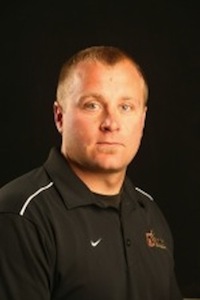
For San Diego State’s football program, that’s where Brian Murphy comes in.
A graduate of SDSU, Murphy was able to get a job as a video assistant with the San Diego Chargers shortly after college. Following his time with the Chargers, he joined SDSU in 2003 as the head video coordinator and has been a huge part of the Aztecs’ success.
His duties include filming and editing practices and games and overseeing the video room staff and operations. Although he works mainly with football, Murphy also assists with the video needs of other sports.
Murphy also coordinates film exchanges with other schools, a crucial part of the in-season preparation for each game. Through these exchanges, he acquires film of previous games of upcoming opponents, giving the coaching staff the ability to study other teams.
Murphy, who says the 2010 Poinsettia Bowl is the most memorable sporting event he has filmed, loves working for his alma mater. Although workdays can be long and exhausting during the season, Murphy still enjoys coming to his office every day.
“It’s not like a regular job,” Murphy said. “Everybody else goes to cubicles, but I get to go to a football field for work every day. Ever since I started here, I’ve loved it.”
Not only does Murphy do a lot for the program, he is also very good at what he does. During his time at SDSU, he has been awarded the Collegiate Sports Video Association Mountain West Conference Video Coordinator of the Year four times (2003, 2009, 2010, 2012).
“Winning that award meant a lot,” Murphy said. “It’s an award that’s voted on by the video coordinators at other Mountain West schools. Any one of those guys is just as deserving, but it makes me feel good that they voted for me.”
For his hard work and dedication to the Aztec football program, Brian Murphy is this week’s Wednesday Warrior.
On top of his daily work, Murphy also creates a football season preview each year. Here is the 2012 edition:
The focus has now moved on to Army, and signs are posted all around the Fowler Athletics Center
Week 2 is here, and although we suffered a tough loss on Saturday, we are moving on to our next opponent, Army.
We played Army last season, and it was a close game, so we know that we cannot take them lightly. They are a tough-nosed team, and their offense can be frustrating and exhausting. We will need to be very discipline on defense.
Week 2 also means another set of stories is set to be released.
This week’s Warrior Wednesday story will be on SDSU’s video coordinator Brian Murphy. Murphy has been working with SDSU since 2003, and he does a lot for the football program. Be sure to check in on Wednesday to read about his hard work and dedication.
This week’s Throwback Thursday story will be on former SDSU linebacker Russell Allen. Allen currently plays for the Jacksonville Jaguars, and he is entering his fourth season in the NFL. Tune in on Thursday to read about Allen’s time at SDSU and his transition to the NFL.
The Feature Friday story this week will be on linebacker Rob Andrews. A senior, Andrews has battled through injuries throughout his career but has still been a big part of the Aztec defense. Check in on Friday to learn more about him and his journey to where he is today.
Sandifer in the 2010 season (Ernie Anderson/SDSU Media Relations
Sandifer overcomes obstacles on the road to success
In the spring of 2011, San Diego State wide receiver Dominique Sandifer was preparing for a big season. It was his time.
He had played two seasons behind NFL-bound receivers Vincent Brown and DeMarco Sampson, and was ready for his chance to take over as the go-to pass-catcher for the Aztecs. 2012 was supposed to be his breakout year.
Sandifer and his teammates were working hard in the offseason, running routes and catching balls from the quarterbacks one day during a week off.
That day, however, one wrong step would put a halt to Sandifer’s plans, and change his road to success in the blink of an eye.
“We were running routes and I ran simple “go” route, and my knee got stuck in the ground,” Sandifer said. “I was hoping it wasn’t that bad at first, but then they told me my (Anterior Cruciate Ligament) was torn.”
For the average athlete, a severe injury like a torn ACL can be tough to overcome, both mentally and physically.
Luckily for the Aztecs, Sandifer is far from average.
Born in Joliet, Ill., Sandifer moved to California at a young age with his mother and sisters. Although his father wasn’t always around, his mother and grandmother did their best to keep him out of trouble.
Sandifer’s mother lived in Long Beach, Calif., while his grandmother lived in nearby Gardena. He spent time at both houses, but eventually moved in with his grandmother when she was able to get Sandifer and his sister into the Beverly Hills Unified School District through her job with the city.
Sandifer started going to school in Beverly Hills in fourth grade, and also began playing football in Gardena. Because of the congested traffic and his grandmother’s work schedule, he endured long, tiring days at a young age.
“I would wake up at 6 a.m. to go to school, rush home, go to practice, and get back home around 9 p.m. and that was about it,” Sandifer said. “I didn’t have time to go out in the neighborhood or anything. My mom really wanted me to play sports to keep away from gangs and other trouble.”
At Beverly Hills High School, Sandifer impressed the football coaches from start, making the varsity football team as a freshman. He played varsity all four years and caught the eyes of college coaches for his impressive play both at wide receiver and cornerback. Sandifer was an all-CIF selection on offense and defense, and although some colleges were recruiting him as a corner, he wanted to continue playing receiver.
San Diego State was a school that saw Sandifer’s potential at receiver, and offered him a scholarship. After taking an official visit, he and his mother agreed that it was the right school, and he made what he calls “the best decision of his life.”
After redshirting in 2008, Sandifer was a key contributor in the third receiver role for the next two seasons. He played in 23 games in 2009 and 2010, notching 49 catches for 561 yards and 2 touchdowns. Although it was frustrating at times playing behind Brown and Sampson, Sandifer learned a lot from the experience.
“It was hard at first, coming in with an idea of how you want to play, but I learned you have to wait your turn and work from the bottom up,” he said. “I ended up learning a lot from them; they were great leaders and it reflected a lot on who I am now.”
Then came the injury.
“It was tough to overcome because I felt like I had paid my dues,” Sandifer said. “I felt it was my turn to step up and prove to everybody that I could be the guy.
It was an extremely hard time in Sandifer’s life, but equally important.
“I feel like everything happens for a reason, and I felt like I got to tutor the young guys and give them the knowledge that I learned from Vincent and DeMarco,” he said. “Now we are deeper at receiver than we’ve ever been. You have to take a positive from everything. If it would help the team, I’d do it all again.”
Cornerback Josh Wade, Sandifer’s good friend and roommate, saw the growth in Sandifer throughout the recovery process. Wade was in a similar situation, as he missed the entire 2011 season due to a torn Achilles tendon.
“It was definitely a maturing process for him,” Wade said. “We both grew up a lot from sitting out and watching the game from a different perspective. It helped that we were going through it together.”
With the 2012 season approaching, Sandifer is back and ready to help the Aztecs any way he can in his final season. A week before the season started, Sandifer was voted as one of three team captains by his teammates, an accomplishment that he will cherish forever.
“That was special,” Sandifer said. “I was a captain in high school, but at the college level it’s really special. It showed me that my teammates respect me and trust me enough to be the captain. It was a humbling experience and I appreciated it a lot.”
In a perfect world, Sandifer hopes to have a successful senior year and get a chance to make an NFL roster next year, but he has made certain to focus on his academics to prepare for life after football. He graduated in the spring with a degree in child in family development, and is now pursuing a master’s degree in rehabilitation counseling.
If football doesn’t work out, Sandifer hopes to work with athletes with disabilities and athletes seeking direction once their playing career is over.
“I want to reach out and help kids,” Sandifer said. “I feel like you shouldn’t be able to tell a kid who was born without a leg that you can’t run. I also want to help athletes who finish sports. I want to help those guys get jobs and stay away from drugs and financial issues.
“A lot of those guys don’t know what to do after sports, they have no direction. Sports is just a short part of your life, and hopefully I can reach out to those people and help them understand that.”
Although he took a small detour, Sandifer is still on track on the road of success. Luckily for others, he is more than willing to share the directions.


 Aztecs For Life | SDSU Blog